I couldn’t have put it any more succinctly than this guy. Thank God I’m not the only one
Tag: album review
Classic Album Series: I’m Still In Love With You, Al Green (1972)
Al Green has become almost as cliche as a Barry White song, play anything by him and it’s just love-making music, damn good love-making music, but I think people rarely venture beyond the first few words of an Al Green song before it becomes background mood music, and it’s a damn shame. Sure “Tired of Being Alone” and “Let’s Stay Together” will go down in history as some of the most sensual songs not sung by a 32 year old man to a 16 year-old girl (see Marvin Gaye, “Let’s Get It On”) but its too short-sighted, and too easy to just say that Mr. Green was probably the soundtrack to 1/3 of the population conceived after 1972.

To be fair, Al Green wasn’t trying to set the world on fire with poetic lyrics, his greatest strength was interpreting a song and filling it with emotion, an ability that can even make the simplest lyrics have deeper meaning. We crave authenticity in art, and Al Green’s delivery had that in spades. That is what turns “Simply Beautiful” from being sap into gold. In essence, that’s what makes Al Green’s I’m Still In Love With You a special album, even the weakest lyrical numbers on here become great songs just because of the emotion put into them.
And yet, I haven’t even mentioned the circumstances surrounding Al Green, he had released Let’s Stay Together months before I’m Still In Love With You came out, an album that meant 1972 was already the year of Al Green with its tremendous title track and an even more stunning interpretation of the Bee Gee’s “How Can You Mend A Broken Heart” but there’s a difference between the two releases that makes I’m Still In Love With You the better album for the same reason that Let’s Stay Together has more standout tracks and that is the production.
What makes “Let’s Stay Together” “I’ve Never Found A Girl” and “How Can You Mend A Broken Heart” great songs is the fact that they stand out from the rest of the album, their production is on another level, for “Together” you’re instantly drawn to that warm low end, the punch of the horns with the syncopated drums that makes that introduction so productive, the riffing and bright horn play on “Girl”, and “Broken Heart” well I’d be damned if that song doesn’t lay the whole foundation for I’m Still In Love With You with that organ bubbling and smoldering in the background and Al Green’s vocals so intimate that the microphone was probably weeping.
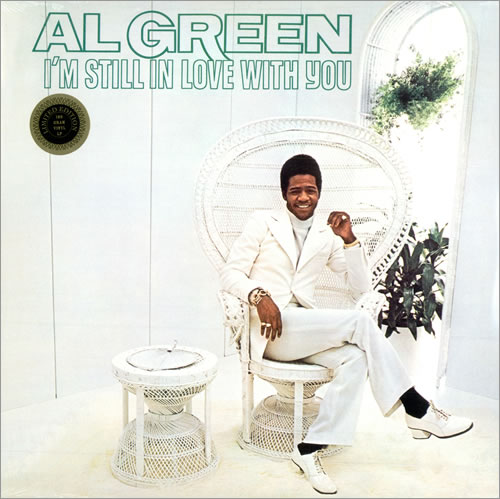
Side One:
Much like Let’s Stay Together, I’m Still in Love With You starts with the title cut, even aping the intro with the punchy horn and drum shuffle, but Green’s vocal comes out dream like, a drawing of breath “Spending my days, thinking about you girl…” as he trails off, in media res and without a doubt you know the title to be true. Already the arrangement has a different feel from his previous more energetic funk laden album, the organ whirls, the strings are warm, the sharpness is gone from the record. There’s also some great backing vocals here, and even a little funky horn break, but Green’s ability to sound breathless and overcome with emotion makes this an amazing song.
There’s a simple reason why “I’m Glad You’re Mine” is one of my favorites on the album and it’s mostly due to the drumming, more specifically that off-kilter tom hit that sets the pace for the bluesy slow funk groove, but the swooning strings almost steal the show amidst a rising and falling organ and some great harmonizing vocals by Mr. Green.
Then, a sole slow guitar strum beginnings the slow open to “Love and Happiness” one of Al Green’s better known songs, and it’s the closest he gets to universal truths from his lyrics, it’s “something that can make you do wrong/make you do right”. Happiness is “being in love with someone” pure and simple.
What A Wonderful Thing Love Is
“What A Wonderful Thing Love Is” which features one of the best guitar melodies and bass grooves in soul music, unveils itself to the listener, much like the eureka moment of realizing you’re in love with someone, it’s a beautiful shining moment, and Green effortlessly captures it here.
“Simply Beautiful” is Green’s take them to church moment, building from a solitary acoustic guitar and simple drum arrangement, his performance simmers with nuanced emotion as strings and organs bring the song to its climax. But the pure heart and soul of the song is how his pleading vocal and guitar lines intertwine to become one.
Side 2:
“Oh, Pretty Woman” starts the second side of the LP, and it’s a cover of the famous Roy Orbison song done in Green’s soul style and the real highlight is the chorus wherein Green’s multi-tracked harmonies are love personified, warm and inviting, pleasing, soothing. While it may get the back-burner in relation to his beautiful cover that follows this one, it’s by no means a weak track.
“For the Good Times” showcases Green at his best as an interpreter of other’s material. It makes perfect sense in hindsight that a soul singer could take country and make it work. Both are built out of stark heartbreak, but they played to different audiences. Country was the stereotypical genre of the blue-collar southern man while soul was the secular music that came out of the gospel music of the black church. Originally a Kris Kristofferson song, Green transforms the original into a slow waltz, accentuating Kristofferson’s original words with a back and forth vocal performance, echoing the sway of the arrangement.
“Look What You’ve Done For Me” features an incredible groove that would be powerful even without the horn-backed chorus (which surprisingly detracts here), it features some of the better backing organ and guitar work on the album, while the drumming pops out of the pocket like a force to be reckoned with. The lyrics here are also incredibly heartfelt “But now the day has come/ to let you know where I’m coming from/ the best of my years to go to you/ is the only thing I can do” may seem trite but when you really do look at love, that’s one of the most sincere promises one can make, and there’s no sign that Green doesn’t mean it.
“One of These Good Old Days” is the last song on the album and features a quite celebratory arrangement and lyrics that reinforce the title of the album, talking about how much he loves his woman seen through an impending discussion. What’s quite fun is Green’s usage of call and response on here almost turning into a vocal round by the end with his trademark falsetto outcries.
If you love music as much as I do, you should by all means have this record. I’m Still In Love With You would be regarded as phenomenal even if Let’s Stay Together didn’t come out the same year, the fact that it did without a lapse in quality is even better. Furthermore, writing about this record song by song was an even harder task just by the sheer cohesive output. The world that Al Green is able to both create and inhabit in his music is so emotive even within the same basic backing. Yet no one else could sound the same using the simple instrumentation that Green does here. The swirling organ, symphonic strings, slinking guitar lines and downright sexy vocals would never find an equal. The greatest joy of this album is the ability to just sit right down and listen to it straight through, each song distinctive, but still chapters of the same story.
New Classics: Looking Back On Big Echo by The Morning Benders (2010)
Of the many albums that have come out in my years as a music blogger, there are a choice few that really stand out as excellent albums and one of my favorites, the one that I will start with, is Big Echo by The Morning Benders.
It’s strange to realize that the album, or LP (whichever suits your preference) has once again taken a back seat to the single. Thanks to the internet’s ability to grant us instant gratification, most listeners no longer have the patience to sit through an album. iTunes and other per-MP3 vendors are in part responsible for this, as it’s a much cheaper deal to buy a single song for a dollar than a whole album for 10 or more.
But what of the exceptions? The listeners who do still crave a full album experience? It’s for them that I chose Big Echo, an album whose first 4 tracks are absolutely stellar as stand alone numbers, while the remaining tracks work more as a cohesive unit, one that rewards repeated listens.


First things first: The Morning Benders area band out of the Berkeley area of California who hit the scene in 2008 with a roots rock debut called Talking Through Tin Cans. It was an album dominated by simple no-frills production and quick hooks on the likes of “Damnit Anna” and “Waiting For A War,” and the overall effect was one of a 60’s pop production with most numbers shy from straying over the 3:00 mark. Their talent for good old fashioned melody was evident, but nothing on the album registered beyond the point of simple enjoyment.
A Bedroom Covers LP later (an album which consisted of eclectic handpicked tracks ranging from the 50’s-90’s, produced in a bedroom) The Morning Benders’ second album, Big Echo, emerged out of nowhere in March 2010, an inauspicious release date. In fact, Big Echo’s largest marketing campaign was in viral form: a beautiful live version of the lead track “Excuses” done by the LaBlogotheque-esque music blog Yrs Truly.
Big Echo starts with the aforementioned “Excuses,” a song that band leader Chris Chu indebted to Phil Spector’s Wall of Sound production. He pulls it off beautifully: from the scratching of vinyl intro to the smoldering tympanis and piano flourishes to the bombastic transformation into a classic 50’s chord progression with occasional Etta James “At Last” violin to the bittersweet vocals coming full circle about a past relationship. The bridge is a awe-striking vocal round that builds into a crescendo from all sides that takes the song to its swirling finish.
The second track, "Promises,“ probably owes the most to the album’s co-producer, Chris Taylor (of the band Grizzly Bear). With its shimmering production and vocal harmonies and its dynamic changes of tempo, it’s not a long stretch to compare "Promises” to Grizzly Bear’s hit “Two Weeks. It’s to the Morning Benders credit that they don’t sound derivative, thanks in part to Chris Chu taking a clever approach to his vocals by layering a low and high octave together.
Meanwhile track 3, "Wet Cement,” takes the album into a slower turn. It’s a beautiful bass-driven number with compressed piano and slow-strum plucked guitar chords, and it finds Chris Chu in his high falsetto. The track has an utterly hypnotic feel with great meandering guitar leads that could have come out of Paul McCartney’s Ram. Certainly, it’s an album highlight.
“Cold War” fits the instant gratification mold, a radio ready single that comes in just under the 2:00 mark and features a chord progression that grabs you from the start. But the track is really a testament to the Benders’ focus on production with booming tympani work and a golden acoustic guitar sound, highlighted by glockenspiel. It’s one of those perfect summery over-too-soon numbers that bears up to looping.
Track 5, “Pleasure Sighs,” is a departure from its predecessors. With its slow pace and hypnotic vocal and guitar interplay, it’s a number equally fitting to the dreamy sounds of Dark Side of the Moon and the late 60’s psychedelia of Abbey Road, a grandiose epic number that completely changes the direction of the album.
Track 6, “Hand Me Downs,” starts out with an utterly creepy twinkling of pianos before a rhythmic propulsion of drums and guitars take over. Here is where you notice the great drum-work that has been the framework behind every song. Drummer Julian Harmon isn’t exactly on the tip of the tongues of those who rank great modern drummers, but he should be. “Hand Me Downs” has its hands full of sonic tricks, from layered vocals to hard hitting guitars drifting off into reverbial bliss and Chris Chu alternating his vocals from aggressive to ethereal.
Track 7, “Mason Jar,” once again picks up the trippy Dark Side of The Moon vibe, though this time with more of a Radiohead meld, via a cleanly picked guitar line paired with an eerie backdrop of rising and falling synths. Spot-on instrumentation adds to the song’s prickly texture.
Track 8, “All Day Day Light,” serves almost as a respite from the heavy songs that followed “Cold War.” It’s the most by-the-numbers type of rocker that you’ll find on the album, and wakes up the listener with its bright guitar work, reverbed handclaps and upbeat drums
Track 9, “Stitches,” may be the most unheralded song on the album, and the most deceptively beautiful. Its dynamics transition seamlessly from a whisper to a shout and completely surround the listener by the song’s finale
Big Echo’s final track,“Sleeping In,” isn’t your typical rock number. It’s built around more of Chu’s amazing vocal layering which I’d say is some of the most rewarding since The Beach Boys’ Pet Sounds.
So Why Did I Chose Big Echo?
After discovering The Morning Benders from their first LP, it was hard for me to imagine that their sound would evolve so dramatically without any typical sophmore slump drop-off. Ye,t as different as the two albums sound, Big Echo maintains the melodic hooks that were so promising on Talking Through Tin Cans and expands on them, with production that continues to fascinate after repeated listens.
The overral cohesiveness of an album, not just thematically, but sonically, plays an important and undervalued role in today’s music. The Beatles were more aware than most in what separates the good from the great. Not only can one identify a Beatles’ number almost immediately, but also the album that it belongs on and the sequence surrounding it. This sense of place is really what should define an album and The Morning Benders pull it off in spades.
To their credit, while each track is related to its brothers, Big Echo’s production is never repetitive. Instead, we’re invited into the world of each individual song, from the bittersweet “Excuses” to the explosive pop of “Cold War” all the way to the mesmerizing vocals of “Sleeping In” without forgetting the importance of melody throughout.
Content too is important, and while Big Echo has the overarching theme of the rise and fall of relationships, it’s done in a rather abstract and refreshing way, with deceptively simple lines that range from outright sexual (“You tried to taste me/And I took my tongue to the southern tip of your body”) to cynical (“Stuck in a mason jar/ where I sealed up my heart/I take it out once a week/ to donate to charity”) to cleverly allegorical (“Cold War” refers to the narrator’s wish to keep a lovers’ quarrel from getting out of hand). At 10 songs, Big Echo’s brevity (clocking in at a little under 40 minutes) allowed me to come back again and again, without feeling the need to skip around songs and both it’s title and artwork draw a parallel to the music.
And yet most importantly, The Morning Benders seem content to challenge themselves, they could have easily gotten away with another Talking Through Tin Cans soundalike, but their progress has proven that they are an exciting band to follow in the years to come. To me, Big Echo is a modern day Pet Sounds where the overall melodic structure won me over and at no time did the “pocket symphony” production drive me away. Chris Chu and company have produced an album that builds upon the past as well as moves towards the future.
Ratings Score:
Production Values: 5/5
Vocals: 4.5/5
Instrumentation: 4.5/5
Lyrics: 4/5
Repeated Listening: 5/5
Overall score: 9.2/10
New Classics: Sad Songs For Dirty Lovers by The National (2003)
Love being a losing game was a big theme back in 2003, the year of Beck’s Sea Change and its equal partner in romantic shame, Sad Songs For Dirty Lovers. So why did one become instantly lauded as one of the greatest albums of all time (Sea Change) and one fall through the cracks (Sad Songs For Dirty Lovers)? The simple answer would be name recognition, with Beck holding the obvious advantage over a Brooklyn by way of Cincinnati band’s sophomore effort. Yet Sad Songs For Dirty Lovers is the better album.


Both albums boast some of the most gorgeous production of any album in the aught’s. Beck’s is more grand in scope, with lush arrangements dominating the entire affair; spaced out acoustic guitars, twinkling electric guitars, shuffled drumming, all allowing his haunted voice to take the fold. The National take a much more concentrated approach, putting their production eggs in separate baskets.
The National formed in 1999, in the echoes of the dot com boom in bustling New York City, though they had met back in Cincinnati, “home to Pete Rose and the first Filet-O-Fish” drummer Bryan Devendorf would affectionately remark. when they released their self-titled debut album two years later, they had hardly played a gig. The National did not fall on deaf ears however, earning praise from critics like Jason MacNeil of No Depression stating “From the opening notes of “Beautiful Head”, the delicate line between polished roots-oriented pop and alt-country has rarely been walked so deliberately with the payoff so favorable.” Already the quintet which featured two sets of twins, was becoming more than just a novelty.
Certainly their subject matter wasn’t. Matt Berninger was a crepuscular narrator, a character out of Frank Sinatra’s In The Wee Small Hours, perpetually falling in and out of love, perpetually the victim of the sadness of broken-down bar life. “Do not tell me I’ve changed” he sighs on one number “you’re just raising your standards, do not give me away”. Berninger’s oblique poetry is often a victim of intelligent design, a sad acknowledgement that he is responsible for things that he can not understand. For a follow up album, the question became how does an emotionally mature band improve? The answers on Sad Songs for Dirty Lovers are simple; production and focus.
The National was an album of simple arrangements, bar bruised rock with emotion harvested from Bruce Springsteen’s Nebraska and poetry borrowed from the likes of Leonard Cohen and Tom Waits. Then came Sad Songs For Dirty Lovers:
The opener “Cardinal Song” is a gorgeous mind bender, a fraternal twin to the Sea Change sound that launched Beck into the critical stratosphere. Here, Berninger’s vocals are so up front in the recording that its not only the mic that he’s cradling, but the listener’s ear. His voice hushed, half whispering, half admonishing “Never look them in the eye, never tell the truth.” It’s an emotional tour-de-force and a lesson for humanity. “Jesus Christ you have confused me, Cornered, wasted, blessed, and used me” Berninger croons amidst wise words “Never tell the one you love that you do, Save it for the deathbed, And do everything she’d never do.”
“Slipping Husband” takes an immediate turn to straightforward rock, “You could have been a legend but you became a father, that’s what you are today, that’s what you are today.” Berninger converses, a narrator speaking to himself in the third person. It’s a dark take on a dream deferred but a convincing one, equating thinking of what could have been as “acting like a kid.”
“90-Mile Water Wall” is a clear highlight, and it drips like a classic western, a “Lonesome Dove” in winter’s twilight. “ Well I know that you know that you’ve become the target of this hand, with never even asking.” It’s a great table setter for some of Berninger’s greatest lyrics, the action constantly overwhelming the ability to react. The arrangement truly shines here, bolstered by some great violin and guitar interplay, upfront and utterly transparent, a Cormac McCarthy novel in song form.
“It Never Happened” is a dark brood on the end of youth “We look younger than we feel, and older than we are” declares the narrator, pleading “Lover put me in your beautiful bed, and cover me" where the song dovetails into a swirling instrumental from Dark Side of the Moon. because "nothing ever happens to the beautiful.”
“Murder Me Rachel” is where things start to get more caustic. Wiry guitars scream and hum reflecting the hurt of the narrator who’s glimpsed his old flame with a new “pretty boy”. "Say goodbye to pretty boy" he warns, the admittance that he “loved her to ribbons” is a haunting image, an instant connection between the pretty little garnishments and his love being cut and slashed into little pieces. It’s purposeful that pretty boy could be both the narrator and the faceless competitor and it’s the fiercest song on the album.
“Thirsty” is a natural progression from the anger that burst to the surface in “Murder Me Rachel” it’s intensely guarded, referencing fairytales and using alliterative imagery. It’s fitting that the narrator feels weak referencing his “girly arms” and can neither “have a hawk in [his] heart” nor a “dumbass dove in [his] brain”. The shock of the development in “Murder Me Rachel” has left him aimless and defenseless.
“Available” is lyrically two-fold, both a diatribe against a faceless one-night stand, and against his former lover. “Did you dress me down and liquor me up, To make me last for the one minute, When the red comes over you, Like it does when you’re filled with love, Or whatever you call it.” That poor soul that dared take this brooding man home for what was supposed to be a simple night of fun.
The next two songs, “Sugar Wife” and “Trophy Wife” eschew the traditional gender roles and reverse them. “Sugar Wife” is a plea for a wife to make him a man, an ironic twist on the usual role of a Sugar Daddy. He wants to become a dad, pushing for a semblance of meaning. The arrangement here too reflects a lighter mood with some warm harmonies and golden guitar.
“Trophy Wife” is another push at breaking from the sadness and anger that enveloped the narrator, but grounded in the fact that “No one wants to be, no no ones lover, No matter what they say, Lovers know they are the ones, Who one day have to go.”
“Fashion Coat” is a song of juxtapositions, a man who “floats around [his] city” but remains grounded by the fact that “everywhere [he is] is just another place without you in it” is filled with desire to do everything to his lover but is fearful of her falling in love, or out of it. The chorus “I die fast in this city, Outside I die slow” is a reflection of being around the woman he loves, versus when he’s without her.
“Patterns of Fairytales” brings us back to the production of “Cardinal Song”, with a swirling organ and gorgeous guitar work amidst wistful lyrics about a woman gone. The narrator resolves to lie in bed and listen to the music he once made for his love, the memories they once had “And I’m lining up the names, On the mixes I made before you, And I’m turning into fairytales, With glitter and some glue, Everything we ever planned to ever do.”
“Lucky You” ends the album, a slow build of a song with relatively bare production, shimmering acoustic, glimmering electric guitars with a wicked twist on declaring love to someone. “You own me, There’s nothing you can do, You own me, Lucky you.”
More than anything, Sad Songs For Dirty Albums is a reflection on relationships, on the highs and the lows, the being in love and being out of love, but it’s not just your typical breakup album. Bereninger’s narrators reflect and commiserate, juxtaposing the dark reality with the glowing hope, the burn of anger, the shadow of sadness. More than any other, it’s a distinctly human album. The sonic landscape is a city at night, with those that linger long after others have gone to sleep, who meander, wonder, try to shake the reality from their lives. These are the people who brood, drink to take the edge off, youth at its death knell as the depression of adulthood takes over.While Bruce Springsteen was best at reflecting on the burning hope of teenage youth, and the results of falling short of those goals, The National are experts in the agony of adulthood, of trying to mature where hope has deserted you.
Notes On: Production
As a listener, I find texture to be a highly undervalued commodity when it comes to an album, even when they prove to be instrumental in deciphering what makes a good album. Blonde on Blonde had its mercurial electric through a transistor sound, Abbey Road was almost symphonic in its production values, pushing the songs to greater effect with their grandiosity, Dark Side of the Moon had a polish that reverberated off the moon and back. The best albums are linked not only by great songwriting, but cohesive production. On Sad Songs For Dirty Lovers, the production, much like the lyrical content, is largely organic, shading compositions with fantastical elements when the mood calls for it, “Cardinal Song” would be much less effective without the atmosphere thats laid along side it. That’s what makes it such a dynamic record, everything is in its right place.
Album Highlights:
 The Art of the Mixtape