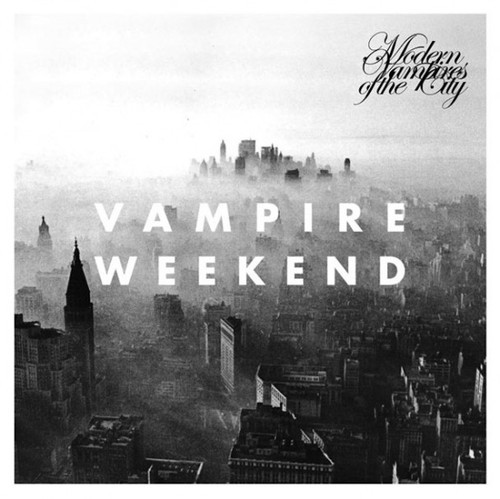

Review: Modern Vampires Of The City, Vampire Weekend

image

image

tried to hate Vampire Weekend. Like many, I found their twee/hyper-literate sensibilities a little too gratingly self-aware.  They would know of mansard roofs, kwassa-kwassa, and Oxford commas. Yet it’s truly hard to absolutely fault a band for their background. So what if they had graduated from Columbia?  Certainly abstract ideas and world influenced rhythms had exploited pop music before, a la The Talking Heads.  Vampire Weekend’s problem seemed to be more of an affectation; they weren’t so much the snooty educated vanguard as they were beloved by the people that were.  Music thrives with identity after all, and those grammatical shindigs found at summer homes in Cape Cod had found a place on the radio. 

There was a temporal and spatial reasoning as well.  The Strokes had become New York City’s musical darlings overnight but had faded just as quickly, their avoidance of emotion, their committal to being non-committal had caught up with them.   2008 was a long time to wait for a new buzz band, and NYC underwent a cultural renaissance. Gone was the romanticism of skeevy lounges and frenetic punk fantasy, in its place a more marketable youth heaven. Shows such as Sex in the City and Gossip Girl not only brought out the high society of NYC life, they made it acceptable, accessible, and lusted after.  Vampire Weekend perfectly fit the mold, thrust into the landscape of hipsterdom, Upper West Side obsession and the ever growing backlash.

Aside from a brief dash of an affair with “Cape Cod Kwassa Kwassa”, “Oxford Comma”, and “The Kids Don’t Stand A Chance”, my strong dislike was successful, they couldn’t be songs that I could delve into, obsess over, rinse and repeat. Their follow-up album, Contra, was little more than a blip of my attention, and even then mostly due to the squabble over the album cover.

Vampire Weekend is almost incessantly tuneful– you need only hear the opening guitar riff to CCKK once before you have it stuck in your head for life. Unfortunately, it infers something worse than a guilty pleasure because you don’t want to be associated with the people (who, it should be said, are derided in the actual song) who are its main subject.  Even the most opined detractors can’t akin Vampire Weekend to talentless hacks. However, on the wave of their debut they were easy to pigeonhole. Koenig recounted in a recent interview “we were essentially the preppy African guitar band.” They’ve been trying to avoid the label ever since.

Vampire Weekend certainly knows their audience. The cheeky urbane types that would delight in showing their friends that Vampire Weekend announced their latest album through an ad in the New York Times, or that they teamed up with Steve Buscemi to venture on psuedo-awkward adventures across the GIF-able city. That’s really the only thing that bothers me, but it is arguably no worse window dressing than many a pop album uses for promotion.  

Here’s the thing, the music trumps all of it. Whereas their debut found them trying to sound different from the pack, Modern Vampires Of The City (horrible title and all) succeeds with pure ambition. 

“Obvious Bicycle” starts the album with spare instrumentation, a compressed piano and a shuffling drum beat that hints at unconventional ( A drum beat that comes from an obscure reggae artist Ras Michael’s “Keep Cool Babylon”). Mortality has already been discussed at length as a theme for this album, but time is also important, as Koenig sarcastically chides his friend “You oughta spare your face the razor/ because no one’s gonna spare the time for you.” The chorus comes across as a soaring hymnal aimed at the reluctant Carpe Diem millennials, “Listen, don’t wait." 

The second song on the album, "Unbelievers”, reminds me of Billy Joel.  Not surprising given Koenig’s proclivity for defending the man.  Especially the harmonizing on the refrain “We know the fire awaits unbelievers/ all of the sinners, the same.” The droning organ and drum interplay also make nice bedfellows with the rising and falling vocals.

“Step” has been glowingly reviewed so far, and it’s easy to see why, with its homespun yet ornate sound collage that could perfectly back a Wes Anderson film. Here, Koenig is perhaps at his most referential and reverential, quoting Souls of Mischief’s “Step To My Girl” (in turn a quote of Grover Washington Jr’s “Aubrey” which is a cover of Bread’s original) The iterations of iterations are telling of the song’s theme, music, and how each generation shapes it and believes their own to be better.  So too does Koenig relate the universality of music, from Dar es Salaam to Berkeley.

“Diane Young”, an obvious homophone of dying young, is Modern Vampires Of The City at its most energetic. Koenig’s vocal jumps like Buddy Holly on speed while the whiplash rhythm section whirls around him.  There’s even a nice bit of vocal manipulation at play here on the chorus (Koenig explained this as an attempt to simulate vocal changes through aging) but the bridge, an apoplectic electronic approximation of a car crash, is a bit jarring. It’s still a tremendously engaging song, even if the Kennedy reference is a little too macabre, considering two of them were assassinated.

The booming organ and drum combination is back on “Don’t Lie”, kissing cousins of J. Giels Band’s “Love Stinks” . The descending bass line is a star here, with a catchy refrain to boot.  "Don’t Lie" is a nice breather after the frenetic “Diane Young” and the build of the arrangement, dashes of harpsichord, strident string arrangements that compliment the cooing vocals, its all here.

“Hannah Hunt” finds Koenig at his most vulnerable, a tale of a relationship that was doomed to fail. The lyrics are heavy on double meanings here, particularly on the refrain where Koenig relates “ Though we live on the US dollar/ you and me, we got our own sense of time.” Time is money, but the homophone (sense, cents) is a nice choice of words as well.  Again, locations are littered, from Providence to Phoenix, Waverly/Lincoln, and Santa Barbara. In that framework, “Hannah tore the New York Times into pieces,” could just as well be the time they spent in New York as the typical paper.  "Hannah Hunt" also features one of the prettier bridges on the album and is an easy favorite on the album.

“Everlasting Arms” might be Modern Vampires Of The City’s most direct confrontation with religion.  Opening with the stark "I took your counsel and I came to ruin, leave me to myself, leave me to myself.“ Koenig quotes the "Dies Irae” a famous hymn of death and destruction, and even models the vocal melody after it in apposition to “Hallelujah”.  It’s a song of contradicting patterns, the sharp dark strings, the soothing vocals. The sense of being alone in the world and begging for a different explanation.

Strangely, I saw one reviewer liken “Worship You” to a hyperactive “I’m Looking Through You”, but if I were to nail a Beatle reference to one song on the album, it would be “Finger Back” with an unholy amalgamation of “I Am The Walrus” and “Hello Goodbye.” Koenig again puts human emotion and religious propriety at odds with the telling spoken bridge “Cuz this Orthodox girl fell in love with the guy at the falafel shop/ And why not? Should she have averted her eyes and/ Just stared at the laminated poster of The Dome of The Rock?” Just as Koenig was at odds with strict grammarians in “Oxford Comma”, he feels the rules are meant to be bent in “Finger Back” too.

“Worship You” is an exercise in vocal calisthenics, not really my favorite on the album, but interesting nonetheless. In an interview, Koenig described it as an attempt at “some kind of celtic song (about 3:44 in)”.  Given that “Worship You” has also been described as “arabesque”, it’s almost uncanny that Koenig had mentioned this nearly eight years ago. 

Many reviewers have also picked up on the fact that “Ya Hey” has managed to both reference God (Yahweh), and one of the most popular songs in the last ten years: Outkast’s “Hey Ya”. It’s a neat parlor trick, and the song is indeed catchy, but the zealous railing against religion is starting to get a little tiresome by this point.

“Hudson” however, throws the album completely on its head: there’s no song quite like it in Vampire Weekend’s oeuvre. It’s a city gone completely dark, apocalyptic, haunting choral arrangements, and intriguingly, a tale of human failures in light of all of the religious foreboding.  Koenig not so subtly implies that the time or place don’t matter, conflicts will always be the same.

“Young Lion” emerges like the dawn after “Hudson”’s dark night, after a flourish of classically styled piano, Vampire Weekend’s harmonies take over, repeating just one simple line “You take your time, young lion” over and over again. Backed only by an upright bass and choral harmonies, “Young Lion” is a sudden, and stunningly gorgeous end to the album.

Vampire Weekend have proven that they are more than just a one-trick pony, highly capable of melody and encompassing darker themes. I really did try to avoid listening to Vampire Weekend once, but with Modern Vampires Of The City, I may have finally stopped worrying and learned to love the music.

Top Songs:

Hannah Hunt

Finger Back

Find Modern Vampires Of The City on:

Amazon (LP)

iTunes

XL Recordings

If You Like Modern Vampires Of The City, try Big Echo by The Morning Benders

Album Review: Stories Don’t End, Dawes

image

Dawes is not a group of ingenue folksters, trying to chase the Mumford & Sons bandwagon until it inevitably crashes into the WOMP-WOMP of bullshit dub-step. Yet they too have been cast into the sepia-toned “revivalist Americana” bandwagon because– to many– music is sounds and opinions, and Dawes sounded like CSNY, The Eagles, and Jackson Browne furtively conceived love-children with each other (the miracles of science!) to create the unassuming North Hills, Dawes’ debut LP.  The “Y” of CSNY and the Jackson Browne would seemingly renew their vows on the follow-up, 2011’s Nothing Is Wrong. “Laurel Canyon” would be thrown around a lot too, because the indie music scene is desperate to prove connections to music’s past, while avoiding music’s present.


Dawes first burst onto the scene in 2009, recording their debut album on such a shoestring budget that bass player Wylie Gelber had to use a guitar amp to record his lines. Their dedication to analog–and their monstrous touring efforts– brought an energetic sound to the affair, and an “old” one.  People claim that sound is warmer, richer on analog, or at least more natural, and so North Hills was imbued with a sound of the California groups of old, guitars crackling, the bass striding with warm tones and the imperfect cracks of the snare, muddled, not the digital isolated noise we’ve come to accept. It was a fly on the wall record of a live band–it could have been a lost outtake of The Band–and it won the hearts and minds.


Of course, the relentless touring schedule played a large part of that, and the choice of “When My Time Comes” as a featured song in a Chevrolet commercial didn’t hurt either.  Goldsmith and company wanted to reflect the touring life in their next LP, Nothing Is Wrong, not romanticizing it, but observations from a life on the road, and the inevitable breaks and bonds along the way. Musically, this truly was an album they could take on the road, energetic ballads with space for solos and sing-alongs, “If I Wanted Someone”, “Fire Away”, “My Way Back Home”, “Time Spent In Los Angeles” all harnessed Dawes instrumental capability and their passion.


One of Dawes’ not so secret weapons is Taylor Goldsmith’s younger brother Griffin, who plays drums, far more than just a capable harmonizer (he’s usually the one who gets backing vocal credit), he’s a fastidious player, practicing for hours and hours on end.  I saw that perfectionism in person when he absolutely nailed a cover of Paul Simon’s “Kodachrome” while playing drums simultaneously. Wylie Gelber is probably the heir apparent to John “The Ox” Entwistle, both in playing ability and in stoic demeanor onstage and keyboardist Tay Strathairn is– in his young thirties– the band’s elder statesman, helping anchor the group that seems determined to be the hardest working rock band in show business.  


Energy and sound can go a long way in a group’s success, but Taylor Goldsmith’s lyrics are the foundation.  He’s arguably the best rock music couplet writer of our time. At least part of this owes to his method – Goldsmith will usually have a title in mind first, and he doesn’t play around with nonsense words to fit a melody. Each line is written to the overall theme, and if it doesn’t fit, it’s forgotten.  It’s of little surprise knowing this, that Goldsmith writes his lyrics on a typewriter.  A computer is prone, almost welcome, to mistakes and flights of fancy, with a typewriter you have to be succinct.  A voracious reader, Goldsmith titled their latest LP, Stories Don’t End from a line in Joan Didion’s novel Democracy


It’s a peculiar choice for those who don’t know what drives Goldsmith– those who like me– were at first drawn to the music, and only slowly let the lyrics sink in.  But Goldsmith has always been a writer fascinated by the intricacy of relationships and the human condition.  The paraphrasing of a Nietzche line– “You can stare into the abyss, but it’s staring right back”– in “When My Time Comes” isn’t chosen to sound educated, or bring in abstract ideas for the “coolness” of it,(In contrast, “Oxford Comma” off Vampire Weekend’s debut LP very much sounds like a band playing up the fact that they’re Columbia students) but to echo where Goldsmith is coming from.  


He’s been glowingly referred to as profound for his age, 27 as of this album, but for Dawes’ past couple albums, this has been skewed by the relatively bright sonic landscape Goldsmith brought with his songwriting.  Frustrated by constantly being labelled as “vintage”, Goldsmith decided to drop the facade on Stories Don’t End.  It’s a much darker album, atmosphere plays a much more heightened role here, laying Goldsmith’s thoughts bare.  The theme of Democracy looms large as well, with Goldsmith’s narrators not so much inconsistent, as aware of the incongruity of narration.  “From A Window Seat”, the first single released from the album, is as much a tale about Goldsmith writing a song about his fears of flight, as it is a song about the fear of flying.  


Perception is a constant theme, on “Most People”, Goldsmith writes of a woman whose thoughts on life  “makes up an image which resists interpretation which is lately how she likes to see herself” and that alone in her thoughts she believes that her hope and despair is unique when “she doesn’t know that most people feel that same way”.  “Just Beneath The Surface” carries the same burden where ostensibly Goldsmith admits there’s always a part of him that will doubt the true intentions behind his actions.  It becomes exceedingly obvious through the course of the album that a relationship is responsible for Goldsmith’s devastation, or a sequence of many that followed the same path.  But Goldsmith manages to–like the most talented songwriters- make the personal universal and give emotional depth to the characters.


Despondent as it may well be, the arrangements are no one-trick pony.  They could have, as Goldsmith amply demonstrated on “Love Is All I Am” and “God Rest My Soul” from North Hills, been successful with a stark acoustic affair.  But there’s an infectious propulsion to combat the somber mood, “From A Window Seat” sparkles with a frenetic Warren Zevonesque piano hook, “Someone Will” (my favorite on the album) bounces along an unexpectedly great rhythm section and a jaunting acoustic guitar melody.  “Most People”’s arrangement probably bears the most resemblance to their sophomore Nothing Is Wrong, but with a great twist in using harmonics as part of the key guitar hook.  “Side Effects” might be the most beautiful arrangement of the bunch, and there isn’t really a weak one, but the dynamics here are exactly what the song calls for; tense and awe-inspiring in all the right places.


This stylistic evolution isn’t without a few stumbles, “Bear Witness” means well, and the arrangement is intriguing, but the lyrical detail sounds ridiculous at parts. Don’t get me wrong, it’s still a better song than many could write, and ambitious, but it doesn’t stand up as well among the album. “Hey Lover” is an intriguing choice, a song written by former bandmate Blake Mills. It would be hard to improve on that original, but its nice to see Griffin and Taylor swap verses and have a little fun on the album.


There’s a lot to like here, and Dawes have proven themselves capable of being more than just a “vintage” band, Goldsmith’s songwriting is on full display, and the band amply backs enough intriguing arrangements to keep the affair from being too dark.


Top Picks: “Someone Will”, “Most People”, “Stories Don’t End”, “From A Window Seat”, “Side Effects”


Stories Don’t End comes out April 9th, 2013


Grab Stories Don’t End (digital) on iTunes

Grab Stories Don’t End (Vinyl, CD, and digital) on Amazon

“The Weight”, Mikal Cronin, MCII

Best known for his collaborations with modern day Marc Bolanite, Ty Segall, Mikal Cronin is starting to carve a name for himself with his own homage to the music of old.  His debut 2011 LP, Mikal Cronin, was a home-spun affair, a psych-garage rock album that brought the roll back in rock.  

This time around Cronin is armed with a full studio production (and major indie label Merge) on the suitably named MCII, a continuation and evolution of his previous work.  "The Weight" benefits from the studio soundscape, there’s tight harmony lines and bristling dynamics, but Cronin is wise to not let the song be overdone with studio polish, the raw energy is still there.

The Weight – Mikal Cronin

RIYL: John Lennon, Elliott Smith, The New Pornographers, Someone Still Loves You Boris Yeltsin

MCII comes out May 7th, 2013 on Merge Records. You can Pre-order it here:


Merge Records

iTunes

“You Take Me As I Am”, Stornoway

Stornoway is a group out of Oxford, England that first made waves with their 2010 debut Beachcombers Windowsill, a folksy, idiosyncratic equivalent to the more electric Arctic Monkeys.  Their new album Tales From Terra Firma, slated for a March 19th release in the United States is not so much a stylistic change as it is a sonic evolution with absolutely stunning and daring arrangement choices that spring them out of the British folksy Mumford and Sons pack.  That the album was recorded in a modest campervan makes the results all the more impressive. “You Take Me As I Am”, the first track on the new album is a propulsive anthem that transforms a narrative about a nascent marriage into an epic synonymous with the power of love.  Fueled by an energetic acoustic guitar backbeat, the arrangement whirls with organs and brass and a dynamic drum line. One of the better tracks to come out this year. Also as a bonus, I’m including “When You Touch Down From Outer Space” a track they recorded during Pitchfork’s Music Festival in Paris as a Takeaway Show with La Blogotheque. 

You Take Me As I Am

When You Touch Down From Outer Space (Takeaway Show)

Pre-order the album on iTunes