
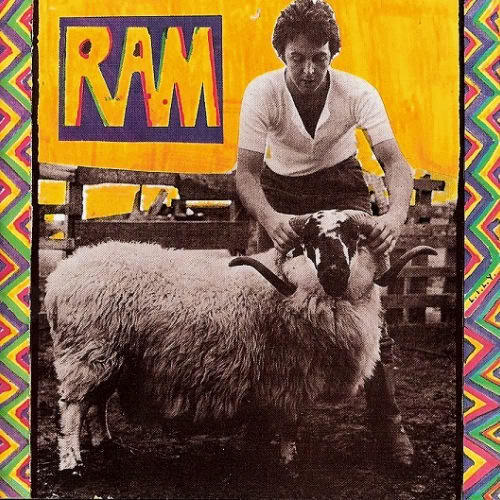
While it is common fact that Paul McCartney officially called the Beatles quits in the spring of 1970, most people don’t realize the immense struggle it put McCartney through. While Lennon, Harrison, and Starr went on with solo careers with the vigor of free men, it was McCartney who seemed to suffer. This struggle was rampant through his songwriting of the time; usually a songwriter who prided on third person narratives and story-telling, McCartney was writing about something completely new, himself. “Two Of Us”, “Let It Be”, “The Long and Winding Road”, “Carry That Weight”, even perhaps “Oh Darling” are all not only skilled love songs and some of his best material, but they also reflect a man troubled on the inside. McCartney, his eponymous debut still showed the scars of this massive breakup, with “Maybe I’m Amazed” and “Junk” both showing the man with his heart on his sleeve, and the ragged production not only a sign of his talent but perhaps his mood at the time.
However, McCartney is too much of a showman, and too much of an immense talent to let such things bother him for long, although his writing partner was perhaps more famed for his fight for the working class, it was McCartney who had really come from one, and thus this hardship was almost a challenge for him to do better. Music never seemed to be the issue, McCartney’s appreciation for music was only eclipsed by his talent for it, and of his previous band’s members, he was the most well rounded. Yet this was an unknown commodity of the time, it was a scarce few people who knew that he had played drums on numbers such as “Back in the U.S.S.R.” and “Dear Prudence” as well as lead guitar on songs such as “Taxman”, “Good Morning, Good Morning” and the like. Many musicians who have met the man in fact will attest that he is a guitarist of prodigious skill, and only limited by his choice to play bass.
So McCartney set about recording Ram in late 1970 and finished in March of 1971. It had been recorded partly in McCartney’s home studio in Scotland, and it was finished in New York. This accounted for the intriguing overall soundscape of the record, it wasn’t quite polished, but it wasn’t as ramshackle as its predecessor , McCartney, had been. The inclusion of a formal studio led McCartney’s whimsical and homespun melodies to get full production treatment, and let his vision be un-compromised in scope.
Critics, hungry for the sound of his former band, were very harsh at first with the overall consensus being that it was full of whimsy but not much else. However as time played its course, many began to find new insight into Paul McCartney’s second album, some even called it the first indie record, a label which given the range of styles found on the record, seems rather fitting. The album, track by track, after the jump.


 The Art of the Mixtape